

Books
By Chris Angermann
How to Mess with Others for Their Own Good
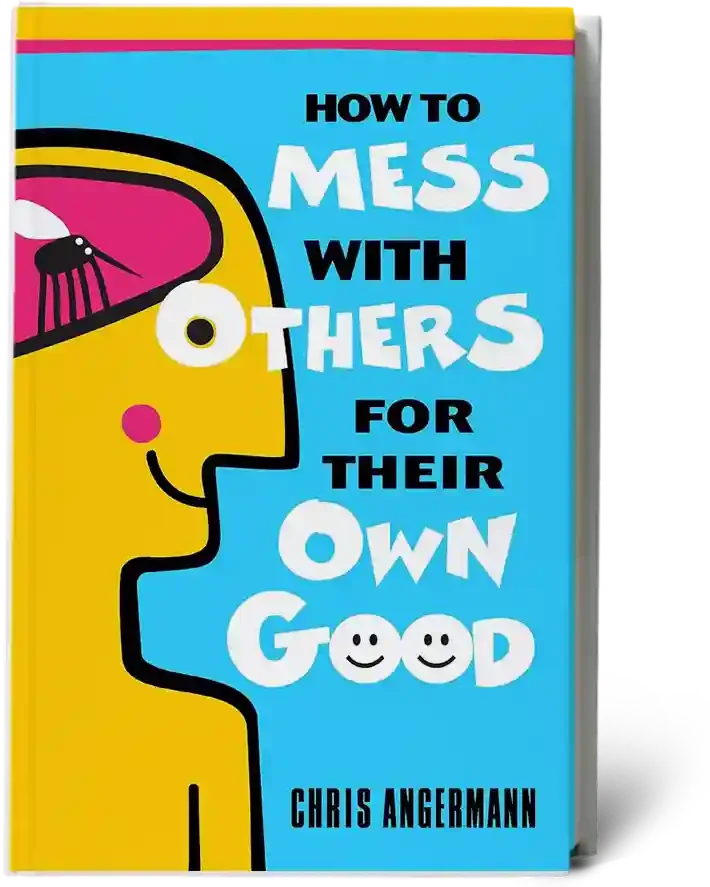
“My satirical take on self-help books, which promise the moon but do little other than take up space on your book shelves. The advice I offer is at least practical, easy to use and provocatively outrageous.”
– Chris Angermann
There’s a spate of self-help books out there that insist you can only change yourself from the inside out. Balderdash! Poppycock!
How to Mess With Others For Their Own Good offers invaluable advice on how to fix everyone else first - real advice that you can put to use right away.
Based on the author’s experiences and observations in many careers and walks of life, you'll learn how to:
Dare to be stupid
Try anything twice
Go crazy
Celebrate stereotypes
Mind manners and adjectives
You’ll also find out all you need to know about sex, relationships, parenting, leadership, apologizing, multitasking, and more.
But the book’s core is “The Real 80/20 Rule” which, if you really get it, will change your life.
Witty, hilarious and wry, these take-no-prisoners recommendations incinerate political correctness, mediocrity and and all-around idiocy with searing humor.
Great guerrilla tools for coping with the upcoming elections, they'll liven up your home and family life, and help you contend with our increasingly exasperating world.
-
From the introduction -
What’s Wrong With Self-Help Books
So let me be clear from the get-go. This book will not lift your spirit, improve your sex life or make you rich. It won’t make you a better person or help you cope with life’s challenges, although you might have more fun if you choose to follow some of its advice.
That’s because it’s not a self-help book.
Most bookstores have shelves heaped full of personal growth and self-development tracts, but what good are they? As the psychologist James Hillman points out in his book We’ve Had a Hundred Years of Therapy and the World’s Getting Worse, “We’ve had a hundred years of therapy and the world’s getting worse.” People are just as depressed and anxious as ever, if not more so.
Why are self-help books so useless? Why do they have so little effect even on people that go through them like boxes of Kleenex during a bad cold?
First, as the inimitable George Carlin pointed out, they’re a misnomer. How can it be “self-help” when you’re utilizing what someone else has written? If you’re really going to help yourself, don’t read a book. Go out and do something.
Second, it’s really hard to get perspective on yourself. “To thine own self be true” may be sound advice—although it comes from Polonius, one of Shakespeare’s great stumble-bums—but only if you know what your real self is. And who but the most elevated and advanced of human beings, someone just this side of the Dalai Lama, can claim to know that and keep a straight face?
Third, self-help books like to divide things up into components, like mental, emotional, physical and spiritual. Having made these distinctions, their authors think they’ve prepared you for the world. It’s like going to a fast-food restaurant and having the server hand you the milk, ice cream, strawberries and whipped cream and say, “Here you go. Now you figure out how to put them together to make a sundae!”
The proof of the pudding is in the way these ingredients interact, overlap and blend into one another. It’s what makes people unique, frustrating, unpredictable and endlessly fascinating. And self-help books never tell you how to do that because their authors have no idea They’re just as cllueless as you are about how to reassemble the ingredients!
That’s why most financial gurus who tell others how to make money, make their money by telling others how to do it. And why so many relationship coaches and marriage counselors have all kinds of advice for staying together and juicing up a relationship, while they’re on their own second, third or even fourth marriage.
The most egregious case—isn’t that a nifty word? Egregious! I first heard it when TV sports commentator Brett Hull used it during intermission of an ice hockey game. I looked it up in the dictionary and have been using it ever since. Which brings me to my first piece of advice—if you don’t know what a word in this book means, look it up! But I digress.
The most egregious case in my lifetime was Maribel Morgan, an anti-feminist author and public speaker in the 1970s, who wrote Total Woman. She had lots of advice on how to spice up a marriage, recommending that the little woman stay at home, put on a sexy negligee for hubby arriving after work, and greet him at the door with a beer or cocktail in hand. What she neglected to tell her audiences was that she made her own marriage work by being away from home more than 200 days a year, telling other women how to become domestic(ated) sex kittens.
Most self-help books are the work of quacks.
One of the more foolish notions these snake oil salesmen have inflicted on the unwary public is the idea that when it comes to making important changes in your life, you have to start with yourself first.
These days, it’s often referred to as “change from the inside out,” and just about every other self-help book that comes along repeats that mantra ad nauseam.
Common sense would tell you that it’s unadulterated hogwash, but people are so insecure about having ideas on their own that they’ll take anyone else’s word over their personal knowledge and experience. Why else the proliferation of media pundits? Got your name on a book? You’re an expert! It’s better than buying a PhD diploma on the Internet. Trust me. Why do you think I wrote this book?
The idea that you can only change yourself flies in the face of reality. There is plenty of change that comes from the outside.
It is possible to teach new tricks even to an old dog, and it doesn’t have to take centuries of therapy; you just need a big enough stick. In other words, it requires the right kind of outside pressure. They’ve figured out how to make diamonds in less than a week in high-pressure vaults, and those gem stones are all but indistinguishable from the ones Mother Nature created by grinding away over millions of years. The same goes for human behavior.
Still, short of the right kind of external force, most people will take the easy way out every time. It’s known as the course of least resistance, and it works very well, thank you very much.
So, if you want to change the world, work to change others. It’s too difficult to step outside of yourself, get objective, and then on top of it start changing yourself. Much too much work, and no fun. Much easier to recognize the problems of others and fix them.
This book then is a return to what most of us have been doing all along—more or less—trying to fix others. If we take charge by giving advice to them, surely—according to the law of what goes around, comes around—someone will take us on as a project. Which is what we’ve wanted all along, isn’t it?
I recommend dispensing advice before you even consider about applying it to yourself. It’s easier, cleaner and more satisfying all around.
After all, it is better to give than to receive. And that’s biblical. You can look it up!
Examples of messing with others for their own good.
Contributions welcome for consideration.
-
A woman went to the doctor's office where she was seen by one of the younger doctors.
After about four minutes in the examination room, she burst out screaming as she ran down the hall.
An older doctor stopped her and asked what the problem was, and she told him her story.
After listening, he had her sit down and relax in another room.
The older doctor marched down the hallway back to where the young doctor was writing on his clipboard.
"What the heck is the matter with you?!" the older doctor demanded. "Mrs. Terry is 79 years old, has four grown children and seven grandchildren, and you told her she was pregnant?"The younger doctor continued writing and without looking up asked, "Does she still have the hiccups?"
-
– Worthy of Henny Youngman, Thank you, Jim Velvet
A man walks into the doctor's with a carrot sticking out of his nose.The doctor says. "You're not eating right.
Dramatic Measures: Lessons from a Life in the Theater
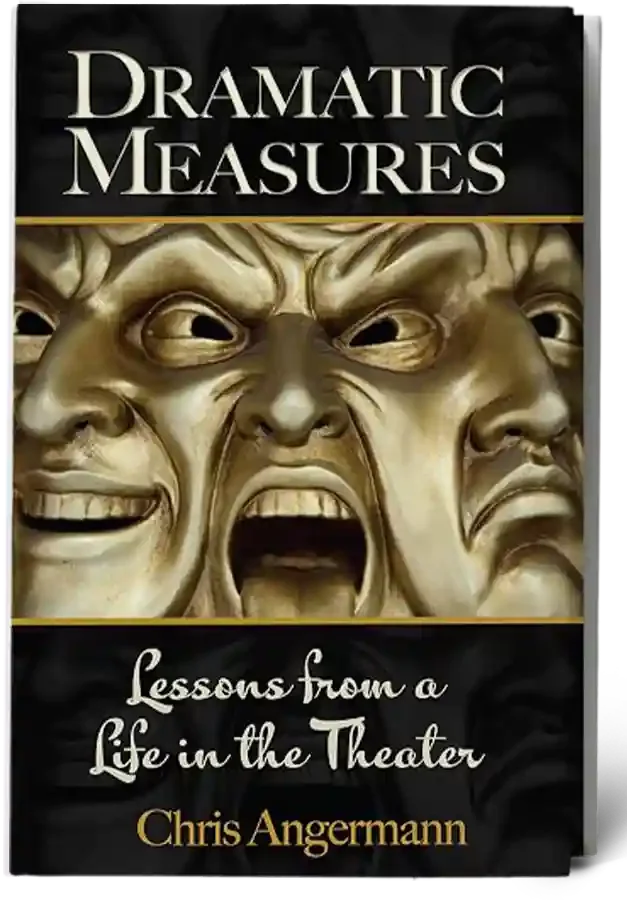
Is Meryl Streep really a good actress? Why are most creative people Democrats? What’s a dramaturg? Why is it important to sing louder at the end? Answers to these questions and tips on acting, directing, and career building in the arts jam-pack this lively memoir about life in the theater.
The author spent nearly 25 years as a professional stage director in New York and regional theater after attending the Yale School of Drama with such future movie and television stars as Oscar-winning actress Frances McDormand, John Turturro, Roc Dutton, Angela Bassett, Kate Burton, and Sabrina Le Beauf. His observations and insights provide a unique peek at life behind the scenes and beyond the curtain for industry professionals and lovers of film, television and the theater alike.
___
“Drawing on his long career in the theater, Chris Angermann has mined a rich vein of source material and created a work that will be a gift to all who read it. Folks with an interest in working in the arts will find helpful guidance in Dramatic Measures; everyone else will enjoy the ringside seat that he provides, and profit from his nuggets of wisdom.”
Rick Davis, Professor of Theater
Dean, College of Visual and Performing Arts, George Mason University
Greater Sarasota: from shorelines to skylines

A coffee table book introducing visitors to Sarasota, Florida, covering the town's history, neighborhoods, business opportunities, tourist venues, and arts and cultural attractions. The book was commissioned by the Chamber of Commerce. I did the research and wrote the text for the various chapters. Sponsors provided their own advertorials.
Yale-New Haven Teachers Institute
Curriculum Units
Shakespeare Active and Eclectic
http://www.yale.edu/ynhti/curriculum/units/1979/5/79.05.01.x.html
Marlowe and Faustus: Visceral Magicians of the Theater
http://www.yale.net/ynhti/curriculum/units/1980/3/80.03.01.x.html
Letters and the Postal Service http://www.yale.edu/ynhti/curriculum/units/1978/1/78.01.02.x.html

Chris Angermann
Over the past five years, Chris has had his hands in the publication of more than 25 books, a number of which have won national awards. "How To Mess With Others For Their Own Good" is his first book under his own name.